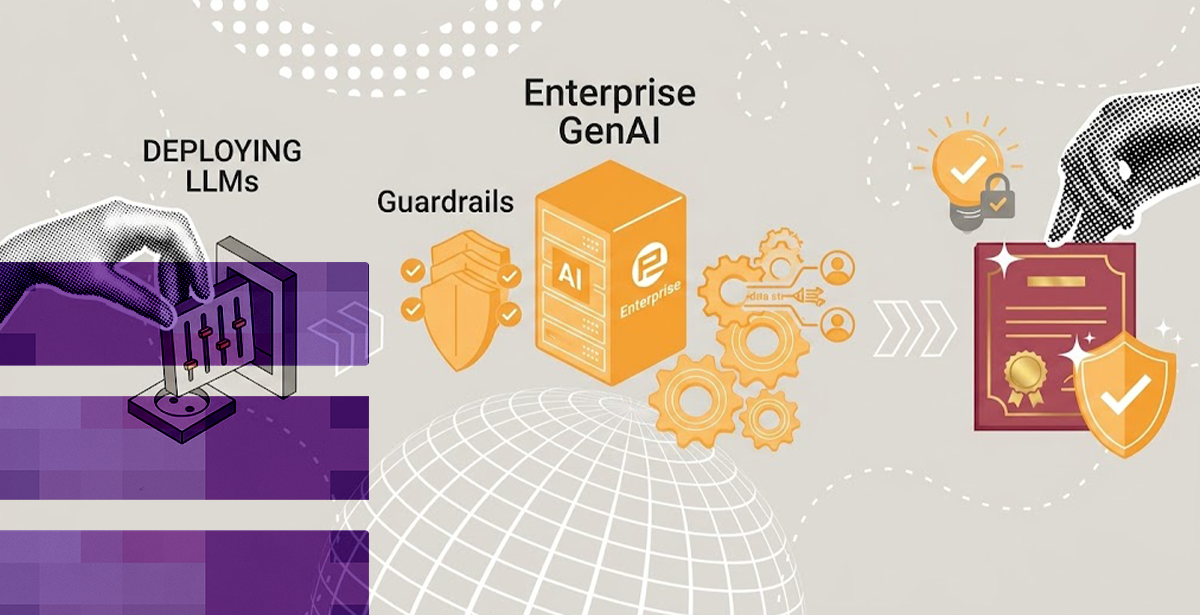
Enterprise Generative AI – Deploying LLMs With the Guardrails Large Organizations Require

The pilot worked. The demo impressed the board. Then the LLM went to production, and everything got complicated.
Data governance questions surfaced. Legal flagged hallucination risks. The compliance team asked how the model would be audited. IT raised data residency concerns.
This is the reality of enterprise generative AI in 2026: the technology is ready, but the organizational scaffolding usually isn’t.
Building that scaffolding, the governance layers, access controls, and monitoring infrastructure, is what separates a proof of concept from a production system.
Why Enterprise LLM Deployments Stall
Enterprise LLM deployment has a specific failure mode: organizations invest heavily in the model itself but neglect the infrastructure around it.
Without proper guardrails, even a well-performing model creates exposure. A customer-facing chatbot that confidently generates incorrect information damages trust. An internal tool that accesses sensitive data without role-based controls becomes a compliance incident waiting to happen.
According to the NIST AI Risk Management Framework, trustworthy AI systems require governance across safety, explainability, privacy, and accountability, not just technical performance. For large organizations, ignoring even one of those dimensions is not a gap. It is a liability.
The Four Pillars of Enterprise GenAI Governance
Getting enterprise generative AI right means building four capabilities in parallel.
1) Data Security and Access Controls
LLMs are only as safe as the data they can access. Production deployments require role-based access controls, data masking, and clear policies governing what the model can retrieve. Every query and every retrieved document is a potential vector for unintended disclosure.
2) Model Auditability and Explainability
Regulated industries in healthcare, finance, and legal services require AI outputs to be explainable. That means logging model inputs and outputs, version-controlling deployed models, and maintaining rollback procedures when behavior drifts.
A robust MLOps pipeline is not optional for production AI. It is the mechanism that keeps models observable and correctable over time.
💡 AI models rarely fail because of poor training—they fail when production data changes. Implement automated monitoring for data drift, model performance, and prediction quality, then trigger retraining workflows when thresholds are exceeded. Continuous validation and automated remediation help keep models accurate, reliable, and aligned with real-world conditions. For that, you should consider having MLOps services to streamline the whole process.
3. Compliance and Regulatory Alignment
Enterprise AI does not operate in a regulatory vacuum. Depending on geography, sector, and use case, organizations must navigate GDPR, HIPAA, SOC 2, and the EU AI Act.
Treating compliance as an architectural input rather than a retrofit is what makes a GenAI enterprise strategy defensible when scrutiny arrives.
4. Grounded Outputs with RAG
Hallucinations are the enemy of enterprise trust.
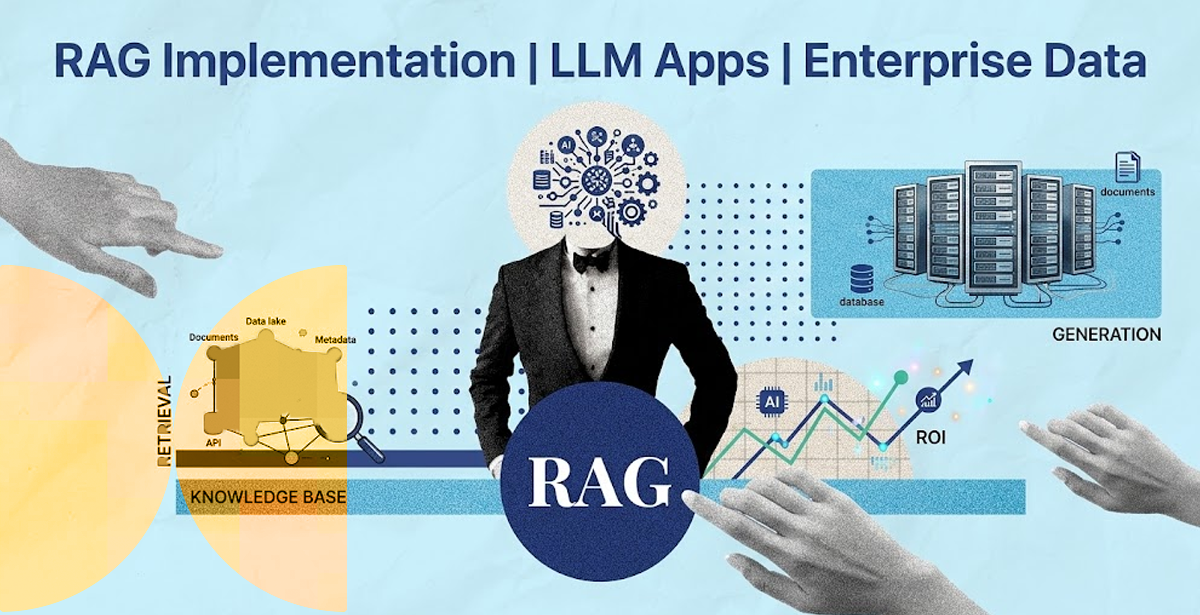
One of the most effective mitigation strategies is Retrieval-Augmented Generation, which grounds model outputs in your verified, organization-controlled knowledge base rather than relying on the model’s parametric memory alone.
The result is responses that are factually grounded, source-traceable, and auditable.
Designing a GenAI Enterprise Strategy That Scales
Most enterprise GenAI strategies fail not because of bad technology choices, but because of sequencing errors. Organizations attempt full production deployments before they have established the foundations.
A better approach is phased deployment. Start with a structured AI proof of concept that tests not just model accuracy, but integration complexity, latency under load, and data access patterns. This phase surfaces governance gaps before they become production incidents.
Layer in monitoring and feedback loops early. Model behavior drifts as training data becomes stale, user inputs evolve, and edge cases multiply.
Embedding MLOps practices from day one means you have the observability infrastructure to catch drift before users do. Then scale horizontally by building a reusable enterprise GenAI platform that other teams can deploy against, converting AI investment from a cost center into a compounding organizational capability.
Enterprise GenAI in Production: Real Deployments, Real Constraints
The challenge with enterprise GenAI is not theory. It is execution in environments where failure has real consequences.
When DPL built an AI-powered complaint management platform for the Sindh Ombudsman, the system had to process 1,000-plus daily complaints with 92% classification accuracy while operating under strict government compliance requirements.
Running on Amazon Bedrock with advanced NLP, it reduced complaint resolution time by 65% and maintained 99.9% uptime. None of that was achievable without data governance and audit logging built into the architecture from day one.
At the enterprise operations level, DPL integrated document AI for National Janitorial Solutions to automatically classify and process 50,000-plus daily work orders, saving 400 hours per week in manual labor.
The key to making it production-grade was controlled data pipelines, structured output schemas, and classification monitoring to catch errors before they reached downstream systems.
Across both deployments, the pattern is the same. Generative AI solutions that hold up in enterprise environments are model-agnostic, cloud-native, compliant, and integrated into existing workflows rather than running as isolated tools.
According to IBM’s enterprise AI research, ongoing monitoring and adaptation are as critical as initial implementation. Models that are deployed and forgotten degrade. That is not a hypothesis; it is a documented pattern.
Additional Queries on Enterprise GenAI Deployment
What is the biggest risk in enterprise LLM deployment?
The biggest risk is deploying without governance. Ungoverned models create compounding risks: security incidents, regulatory exposure, and eroded user trust that is difficult to recover.
How do organizations maintain control over LLM outputs?
The most effective approach combines RAG (to ground outputs in verified knowledge), role-based access controls (to limit retrieval scope), and MLOps pipelines (to monitor output quality over time). These three layers make LLM behavior predictable and auditable.
When should an organization move from PoC to production?
When you can answer yes to all of the following: Have we tested failure modes? Do we have logging and monitoring in place? Is there a rollback plan? Are compliance requirements addressed? If any answer is no, the PoC is not done yet.
Intrigued by Generative AI for Enterprises?
Enterprise generative AI is not a technology problem. It is an organizational readiness problem. The models exist. The infrastructure exists.
What separates leaders from laggards is the discipline to build governance, monitoring, and integration infrastructure before they need it.
DPL has shipped production AI systems across healthcare, government, finance, and manufacturing in environments where the guardrails were not optional.
If you are advancing a digital transformation roadmap built on enterprise AI, we build systems that hold up in production. Explore DPL’s AI engineering capabilities to see what production-grade looks like.