MLOps Services – The Secret to Preventing AI Model Failure

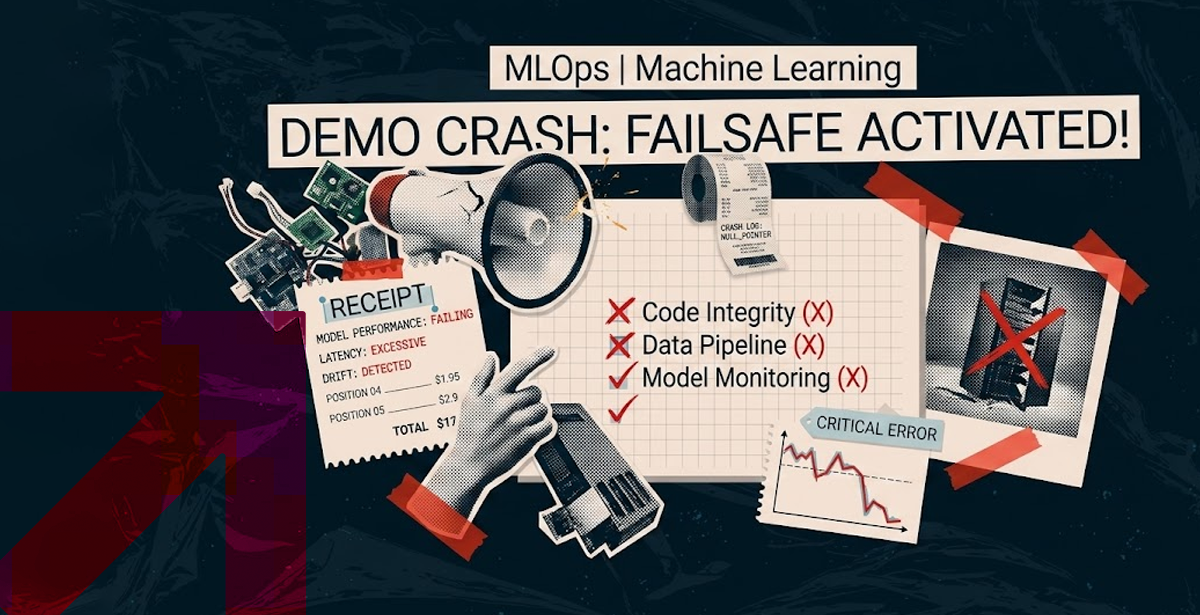
Picture this – your demo went perfectly. The model hit 94% accuracy. Stakeholders left the room excited. Then nothing happened for six months.
This story plays out at companies across every industry. Research from Google’s MLOps team shows that delivering ML systems into production is significantly harder than building them.
Yet most investment still flows toward model development, not operationalization.
The problem is rarely the model. It’s everything that happens, or fails to happen, after the demo.
MLOps services exist to solve this. They provide the systems, processes, and expertise to take a model from notebook to production and keep it performing reliably over time.
Why Most ML Models Never Leave the Lab
Building a machine learning model is the easy part. Operationalizing it is not.
Getting a model into production requires data pipelines, serving infrastructure, monitoring systems, rollback mechanisms, security controls, and ongoing retraining workflows.
Unfortunately, most data science teams aren’t staffed to own all of this. Most software engineering teams have never dealt with the non-deterministic behavior of ML systems.
The gap between those two realities is where models go to die.
According to industry experts such as Martin Fowler, consistently puts the average time to deploy a single model at several months. Many models never deploy at all. The issue isn’t capability. It’s the absence of infrastructure and process.
That’s exactly what MLOps addresses.
What MLOps Services Actually Cover
MLOps stands for Machine Learning Operations. It applies DevOps principles to the full ML lifecycle, from data preparation and training through deployment, monitoring, and retraining.
In practice, MLOps services include:
- Continuous Integration and Delivery for ML – Automated testing of model code, data validation, and deployment pipelines that promote models through staging and production environments without manual handoffs.
- Model Monitoring and Drift Detection – Production models degrade as real-world data shifts. Mature MLOps platforms surface performance degradation automatically, so teams can retrain before business impact compounds.
- Feature Stores and Data Versioning – Reproducibility requires tracking exactly which data trained a given model. Feature stores make this tractable at scale and across teams.
- Model Registries – A central catalog of trained models, versions, performance metrics, and deployment history. This is operational hygiene that most early-stage ML programs simply lack.
- Experiment Tracking – Structured tooling, from MLflow to Amazon SageMaker Experiments, that lets teams compare model runs and make deployment decisions based on evidence rather than intuition.
Together, these components form the backbone of a production-ready ML program. Without them, every deployment is a manual, fragile, one-time event.
💡 When selecting services, distinguish clearly between ML consulting and MLOps consulting. Machine learning consulting is best suited for solving the model-building problem—defining use cases, engineering features, and developing high-performing models in offline environments. Meanwhile, MLOps consulting is essential for solving the productionization problem—deploying models reliably, automating pipelines, and ensuring continuous monitoring, retraining, and governance. Choosing the wrong type of service for your maturity stage often leads to strong prototypes that fail in production.
Where MLOps Platforms Fit in This
MLOps platforms sit at the core of modern ML delivery. Whether cloud-native services like SageMaker, Vertex AI, and Azure ML, or modular stacks built on MLflow and Kubernetes, these platforms provide the execution layer for MLOps practices.
They unify data pipelines, training workflows, model registries, and monitoring into a single operational framework. This reduces fragmentation across tools and ensures that models move through standardized, auditable stages from development to production.
Without a platform layer, MLOps becomes a collection of disconnected tools rather than a governed system.
💡 When evaluating MLOps platforms, focus on how well the platform unifies the end-to-end ML lifecycle. Strong MLOps platform services should integrate pipeline orchestration, model registry, deployment automation, and monitoring into a single governed system. If these capabilities are fragmented across tools, operational complexity increases and production reliability suffers.
When to Bring in MLOps Consulting
Not every organization should build MLOps infrastructure from scratch internally. In many cases, the faster path lies in onboarding specialized MLOps consulting expertise.
It especially makes sense to bring in external expertise when:
- Your data science team is producing models but deployment is the chronic bottleneck.
- You have models in production but lack systematic monitoring or retraining workflows.
- You need MLOps platform services migration from on-premise pipelines to cloud-based infrastructure on AWS or Azure.
- You need a production-grade ML system validated for investors, regulators, or enterprise clients on a timeline of weeks, not quarters.
Good MLOps consulting goes beyond tool selection. It means auditing your existing data architecture, defining operational ownership across teams, and building automation that your internal engineers can sustain after the engagement ends. Just remember, the goal isn’t dependency. It’s capability transfer.
💡 When selecting an ML partner, prioritize two things: end-to-end MLOps support and production-grade observability. Your ML services provider should enable reproducible pipelines, model versioning, and automated deployment, while also providing real-time monitoring for data drift, performance degradation, and inference latency. Without both, models rarely remain reliable in production.
Managed MLOps: Taking Operations Off Your Plate
For many organizations, running ML infrastructure isn’t a core competency. It doesn’t have to be. Managed MLOps lets you hand off that operational burden to a partner with the tooling and expertise to run it well.
Under a managed model, your partner handles infrastructure provisioning, pipeline orchestration, model performance tracking, and incident response. So, your data scientists focus on model development, whereas the engineering team focuses on product.
This approach works especially well in regulated industries. Healthcare and finance organizations face significant auditability and compliance requirements that add overhead to every deployment. A managed partner with domain experience in those environments moves faster and gets it right from the start.
The managed model also suits companies scaling their AI programs rapidly and are in need for operational capacity that outpaces current headcount.
What MLOps Implementation Looks Like in Practice
At DPL, MLOps implementation begins with understanding what’s already in place and identifying exactly what is blocking production deployment.
Our team works across Amazon SageMaker, Azure Machine Learning, and open-source tooling including MLflow and Kubeflow. We design pipelines that are reproducible, auditable, and built to scale with a growing model portfolio.
Take the example of our work for National Janitorial Solutions. We built automated document AI pipelines processing over 50,000 work orders daily with no manual intervention.
Similarly, for Sindh Ombudsman, we deployed a cloud-native AI platform on Amazon Bedrock that cut complaint resolution time by 65% while handling 1,000+ citizen complaints daily at 99.9% availability.
Across healthcare, finance, manufacturing, and government, the pattern holds: organizations that invest in proper MLOps platform services ship models faster, recover from failures faster, and extract more sustained business value from their AI programs.
The Bottom Line
The organizations getting lasting value from machine learning treat model deployment and operations with the same rigor as model development.
MLOps services make that possible, whether you build the capability in-house, bring in consulting expertise, or hand operations to a managed partner.
If your models barely survive after Demo Day, chances are your operational infrastructure is to blame.
Thankfully, that’s fixable. So, contact DPL’s AI engineering services team to operationalize your ML program.