AI Proof of Concept Development: The Smart Way to Validate Innovation

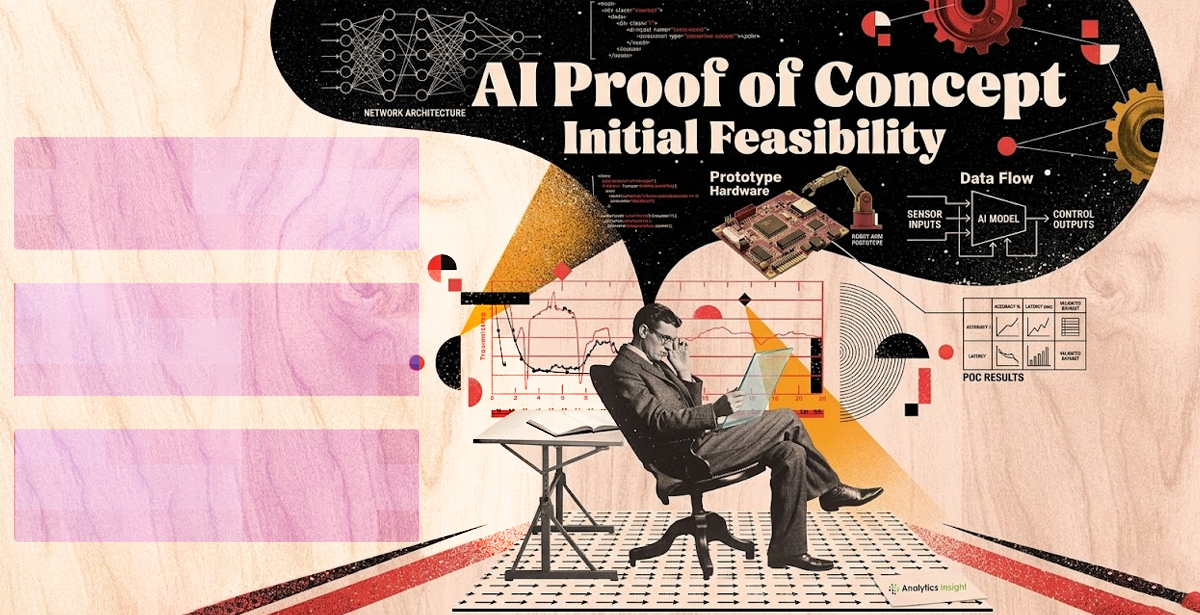
Most AI projects don’t fail in production. They fail long before that.
Teams commit to expensive builds on assumptions that were never tested. The technology, the data, the integration: all of it assumed to work. But often, none of it does.
The solution isn’t better planning. It’s proof.
AI proof of concept development gives teams a fast, structured way to validate whether a proposed AI solution is technically feasible before committing serious resources.
Done right, it surfaces hard truths early, secures stakeholder buy-in, and dramatically improves the odds that the final product ships and delivers real value.
What Is AI Proof of Concept Development?
An AI proof of concept (PoC) is a focused, minimal build designed to answer one question: can this idea actually work?
It’s not a finished product, nor a polished demo. It’s a technical validation that’s built quickly, measured against predefined benchmarks, and used to make a confident go or no-go decision on full development.
A PoC targets the highest-risk component of the proposed AI system. If the goal is a document intelligence platform, the PoC tests whether the chosen model can reliably extract structured data from messy, real-world inputs.
If the goal is predictive maintenance, it validates whether existing sensor data is sufficient to train an accurate model. The faster you answer the hard question, the less money you waste on the wrong path.
Why an AI Feasibility Study Should Come First
Before a PoC begins, an AI feasibility study lays the groundwork. This is a structured analysis that answers key questions upfront:
- Is this technically achievable?
- What data is needed?
- Which approaches are most viable?
- What are the realistic costs and timelines?
Skipping this step is one of the most expensive mistakes in AI development. Teams dive in and discover mid-project that training data is too sparse or that infrastructure cannot support real-time inference.
According to McKinsey’s State of AI research, fewer than half of AI use cases piloted by organizations make it to full-scale deployment. A feasibility study is the filter that changes those odds.
A good feasibility study takes days, not months. It covers a data audit, architecture options, risk identification, and a clear go or no-go recommendation. That way, you can be sure of building the right PoC, not just the fastest one.
The Three-Stage Validation Path: PoC, Prototype, MVP
AI validation isn’t just a single step. It is a sequence. Understanding the distinctions between PoC, prototype, and MVP ensures each stage delivers maximum value.
- A PoC tests feasibility by answering can the AI do what’s required? This output is purely technical, may not have a UI, and may run entirely in a development environment. Instead, it has are defined benchmarks and a clear hypothesis to validate.
- AI prototype development comes next. The prototype adds design, user experience, and workflow integration. It answers: how will this work for real users? Feedback at this stage shapes the architecture before changes become expensive.
- AI MVP development is the final validation stage before full investment. The MVP is a functional, stripped-down version of the system built to gather real-world user feedback and prove market fit, not just technical feasibility.
The best PoC experts will always deliver all three stages in sequence, ensuring no assumption goes untested before the full build begins.
💡Startups don’t fail because they launch too early; they fail because they spend too long building without validating. An MVP helps you test real market demand, gather user feedback, and refine your product before investing heavily in development. Launching small gives startups the agility to learn faster, adapt quicker, and build products customers actually want. So, make sure you fully understand what goes into MVP development for startups and plan for the process before launching your latest idea.
Real AI Prototype Development Wins to Inspire
Frameworks are useful. Proof is better. Here are three examples from our own archives that show how AI proof of concept development can drive measurable outcomes across different industries.
National Janitorial Solutions — Intelligent Work Order Processing
The Facilities Group needed to process 50,000+ work orders daily without scaling back-office headcount.
DPL built a PoC using Google Document AI and GPT-3.5 Turbo to test whether unstructured work order documents could be automatically parsed and routed.
The PoC confirmed feasibility. The production system now saves 400 hours per week in manual processing time.
Hafiz — Quranic Text Verification
This edtech project required authenticating Quranic text across dozens of distinct Arabic calligraphy styles.
DPL’s PoC combined computer vision and NLP to validate whether the model could hit the precision benchmarks required for religious-grade authentication.
The result: 99% precision. The PoC turned a technically uncertain idea into a proven, shippable capability that had never been attempted at this scale.
Michael AI Bot — Mindfulness Support Assistant
Pause, Breathe, Reflect needed to validate whether an emotion-aware AI chatbot could deliver personalized recommendations from a library of 1,000+ mindfulness practices.
DPL built an NLP-powered PoC to test the recommendation engine before any app development began.
The PoC confirmed accurate, real-time responses to emotional context. That validation made the full app development decision straightforward.
All three projects started as questions. The PoC answered each one before significant investment was made. See more examples across industries in DPL’s project portfolio.
What to Look for in AI PoC Services
Not all AI PoC service providers are equal. Three things separate the right proof of concept development partner from the wrong one.
First, domain breadth. AI spans LLMs, computer vision, NLP, predictive analytics, and more. A partner with PoC experience across multiple modalities will identify feasibility risks that a narrowly specialized team will miss.
Second, defined success criteria. A PoC without benchmarks is just an experiment. The right partner defines measurable thresholds before the first line of code is written and holds the work to them.
Third, a clear path forward. The PoC should feed directly into a prototype and MVP roadmap. If your AI PoC services provider can’t show you what comes next, they aren’t built for long-term delivery.
DPL’s AI engineering team brings multi-domain expertise and a structured validation process. That too backed by two decades of shipping AI systems across healthcare, finance, manufacturing, and more.
Validate with the Right AI PoC Services Before You Commit
The biggest risk in AI development isn’t building the wrong system. It’s committing to a full build before knowing whether the right system is even possible.
AI proof of concept development turns assumptions into evidence. It transforms ideas into validated concepts and investment conversations into informed decisions.
Whether you’re a startup stress-testing a novel AI product or an enterprise evaluating AI for a complex operational challenge, the PoC is where value is proven before the real investment begins.
Ready to validate your idea? Book a consultation with DPL’s AI team and take the first step from concept to confidence.