
Document Image Analysis for Intelligent Document Processing

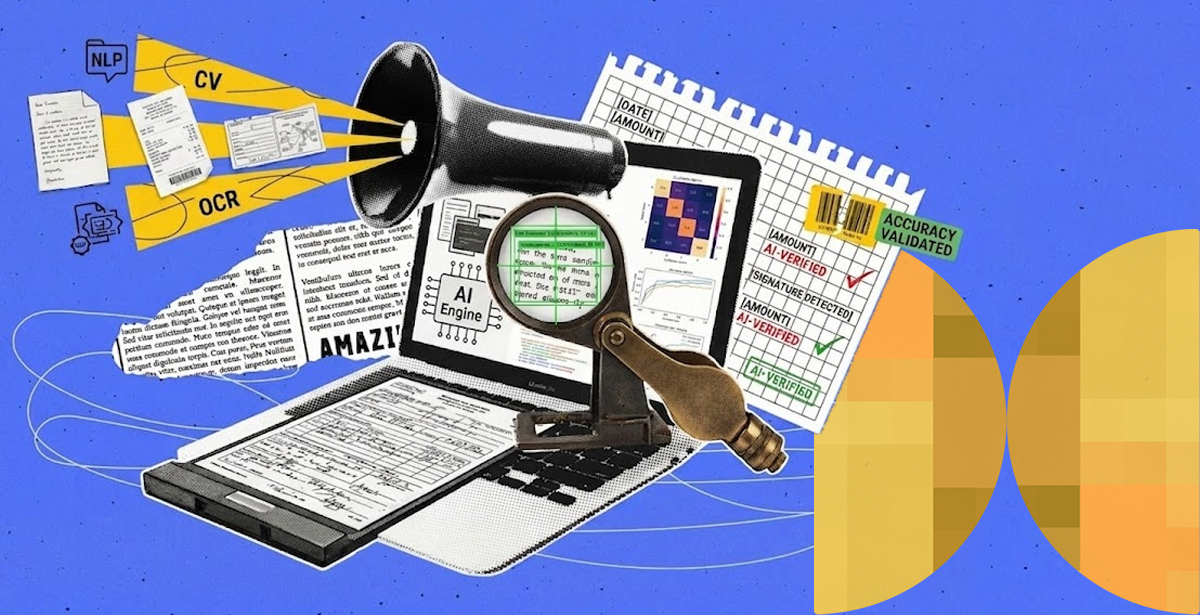
Most enterprise data doesn’t live in a database. It lives in PDFs, scanned invoices, handwritten forms, compliance documents, and photographs of paper records never designed for digital processing.
Traditional digitization methods handle structured, predictable documents well. Document image analysis handles the rest: the variable, high-stakes documents that OCR services have always struggled with.
Why Standard OCR Services Have a Ceiling
Traditional OCR is rule-based. It looks for character patterns in predictable layouts. It works on typed text in standard fonts on clean backgrounds. It falls apart on anything else.
Handwritten notes, variable-format invoices, low-resolution scans, mixed-language documents, and non-standard form layouts defeat rule-based systems quickly.
The performance gap compounds when documents have been photocopied multiple times, annotated by hand, or printed on colored paper. Every layer of processing introduces noise.
That ceiling creates a real business problem. Insurance claims, logistics manifests, regulatory filings, and healthcare records need more than a system built for clean typewritten text.
For industries where accuracy means financial or legal exposure, a 5% error rate isn’t a minor inconvenience. It’s a liability.
💡AI is truly doing wonders for the financial services industry. The technology delivers the greatest impact when it is embedded into transaction processing, risk modeling, fraud detection, and customer analytics workflows. By leveraging machine learning for real-time anomaly detection, predictive scoring, and automated decisioning, institutions can reduce operational latency, improve risk accuracy, and scale data-driven services without proportionally increasing manual oversight. So, consider the possibility of AI business solutions if you haven’t already.
What AI Document Analysis Actually Covers
AI document analysis goes beyond character recognition. It treats a document as both a visual object and a semantic one.
The vision layer handles the image. It handles noise correction, skew adjustment, layout detection, and character extraction using convolutional neural networks trained on domain data.
The intelligence layer handles meaning. It classifies document types, extracts entities like names, dates, and reference numbers, and routes records based on content.
Together, they produce something OCR services never could: documents that a system can act on, not just read.
The output of this pipeline is structured data. A scanned invoice becomes a JSON record with validated line items. A handwritten form becomes a set of extracted fields with confidence scores.
The Accuracy Problem: Why 95% Is Not Enough
According to IDC research, more than 80% of enterprise data is unstructured. The challenge isn’t volume. It is extracting data accurately enough to trust it.
For most use cases, 95% extraction accuracy sounds reasonable. It isn’t. In a batch of 10,000 documents, 95% accuracy means 500 errors.
If those documents are medical records, legal agreements, or financial instruments, each error carries significant risk.
AI-grade intelligent document recognition is designed for the remaining 5%. That means domain-specific model training and human-in-the-loop validation for edge cases. Confidence scoring flags uncertain extractions rather than letting them fail silently.
💡Intelligent Document Recognition (IDR) systems achieve high accuracy by combining OCR with deep learning-based layout analysis and entity extraction models. By segmenting documents into structural components (text blocks, tables, forms) and applying context-aware NLP, IDR can convert unstructured documents into structured, machine-readable data while maintaining field-level validation and confidence scoring for downstream automation.
AI Document Processing Case Studies
The National Janitorial Solutions engagement shows what this looks like at production scale.
DPL integrated Google Document AI and GPT-3.5 Turbo to process 50,000+ daily work orders across 18,000 US locations. The system classifies PDF documents, extracts PO numbers and invoice data, and routes records into a database. The result was 400 hours per week saved in manual labor.
Accuracy requirements, however, mandated a different design for the Digital Quran project.
DPL built a system to extract text from Quranic images and normalize diacritics using NLP. Every extracted segment was validated against an authenticated reference database. To see the full build, read the Digital Quran case study. The target was not speed. It was 99% precision.
Both projects use computer vision as the foundation and NLP as the intelligence layer. The architecture, accuracy targets, and validation logic differ because the use cases do. That’s the core principle of document image analysis: match the solution to the document.
Building the Right Document Digitization Stack
The document type determines the architecture.
High-volume, structured documents like invoices and purchase orders work well with pre-trained cloud models. Variable or novel document types need custom model development trained on domain-specific data. Handwritten or degraded documents require preprocessing pipelines before any recognition layer runs.
AI document processing that treats all documents the same produces inconsistent results across the full range. The right architecture segments the document population, applies the appropriate model, and routes exceptions for human review.
Speed isn’t the only measure. Fast-but-inconsistent processing creates downstream cleanup costs that often exceed the savings.
Organizations managing government records, medical forms, or legal filings also require on-premises or air-gapped deployment options. Cloud accuracy and data sovereignty requirements aren’t mutually exclusive.
Document Image Analysis That Delivers at Scale
Most document digitization projects underestimate document variability. They apply a single solution to a heterogeneous population and measure success only by what worked, ignoring what failed.
DPL’s Sindh Ombudsman platform processed 1,000+ citizen complaints daily: handwritten, typed, and mixed-format documents from across a government system.
The AI layer achieved 92% classification accuracy. It treated each complaint as both a visual and semantic object, not just a text string.
That’s what AI-grade document image analysis delivers. Not a higher OCR percentage. A fundamentally different approach to what documents contain and what happens with their content.
DPL’s AI engineering team has shipped document processing systems across government, logistics, facility management, and education.
If you’re evaluating approaches for your document population, start with a proof of concept. That’s the fastest way to understand what your specific documents actually require.