Predictive Analytics Services: Driving Data-Driven Forecasting

Every business decision carries uncertainty. The question isn’t whether to accept that uncertainty — it’s whether you’re equipped to reduce it.
Predictive analytics services exist for exactly that purpose: turning historical data, behavioral patterns, and real-time signals into forward-looking intelligence that leaders can act on before conditions change.
Organizations that operate on data-driven forecasting don’t just react faster. They position more accurately. They allocate resources where demand is actually heading, not where it’s been. In competitive markets, that gap in foresight compounds over time.
What Are Predictive Analytics Services?
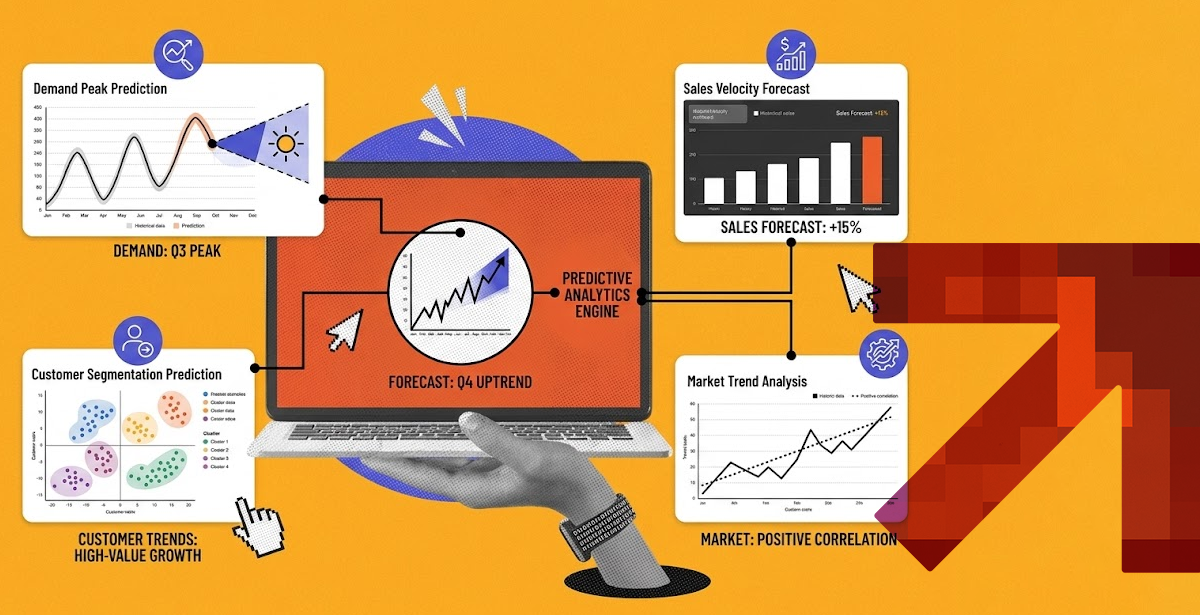
Predictive analytics services apply statistical algorithms, machine learning models, and data engineering to generate probability-weighted forecasts from structured and unstructured data.
Unlike descriptive analytics — which tells you what happened — predictive analytics tells you what’s likely to happen next, and with what confidence. The core output is a model: a mathematical function trained on historical data that generalizes patterns to score new observations.
That model might predict which customers are likely to churn in the next 30 days, which equipment components are approaching failure, or which product SKUs will be in shortage by Q4. The application changes; the underlying logic does not.
The Core Methods Behind Predictive Modeling Services
Enterprise-grade predictive modeling services draw from a toolkit that has grown considerably more powerful with modern ML infrastructure.
- Regression models estimate a continuous output — revenue, load, temperature — based on input variables. They’re interpretable, fast to deploy, and effective for stable, well-understood processes.
- Classification models assign observations to categories: churned or retained, fraudulent or legitimate, high-risk or low-risk. They power everything from credit scoring to demand segmentation.
- Time-series forecasting applies specialized models — ARIMA, Prophet, LSTM networks — to data where sequence and seasonality matter. Inventory planning, energy load forecasting, and HVAC performance prediction all rely heavily on this approach.
- Ensemble methods like gradient boosting and random forests combine multiple models to improve accuracy and robustness. They’re the workhorses of modern tabular data prediction and have won countless industry benchmarks.
The choice of method isn’t academic — it’s driven by data availability, interpretability requirements, latency constraints, and the cost of errors in each direction.
Where Predictive Analytics Solutions Deliver the Most Impact
Predictive analytics solutions are industry-agnostic in their mechanics but highly specific in their applications. Three categories consistently produce the clearest ROI.
- Demand and supply forecasting helps manufacturers, retailers, and logistics providers align inventory to actual demand curves rather than lagged historical averages. According to McKinsey Global Institute, AI-driven demand forecasting can reduce forecasting errors by up to 50% while simultaneously cutting lost sales and inventory carrying costs.
- Customer behavior prediction drives churn models, lifetime value scoring, next-best-offer engines, and personalization systems. When a subscription business can identify at-risk accounts three months before they cancel, the retention economics change fundamentally.
- Risk and fraud detection uses real-time model scoring to flag anomalous transactions, assess credit risk, or detect compliance violations before they escalate. The financial services and insurance sectors have built entire operational infrastructures around this capability.
At DPL, our predictive analytics work spans all three categories — across healthcare, manufacturing, finance, and real estate — with custom model development designed around the specific cost structures and data environments of each client.
The Case for Predictive Maintenance Services
Among all predictive analytics applications, predictive maintenance services stand out for their immediacy and measurability.
The premise is straightforward: sensors on equipment generate continuous streams of operational data. Models learn the signature patterns that precede failure — not generic thresholds, but equipment-specific degradation curves tied to real usage patterns.
A concrete example is DPL’s predictive analytics work with iApartments — an IoT smart home platform deployed across 30,000+ US apartments.
Property managers faced a recurring problem: HVAC units failing unexpectedly, with no early warning system to distinguish normal performance from a system running abnormally long cycles.
DPL built a time-series forecasting model on top of iApartments’ AWS IoT Core data pipeline — analyzing 13+ months of HVAC runtime cycles, idle cycles, and cycle duration trends per unit.
The model established per-apartment performance baselines and surfaced immediate anomalies: one vacant unit was logging 210.5 average runtime hours per cycle, compared to an occupied-unit norm of 1 to 7 hours — a clear signal of a system running without proper cycling.
Alongside flagging outliers, the model predicted future cycle duration trends and triggered proactive alerts to property managers before failures occurred.
The result was a shift from reactive repair to condition-based maintenance — intervening at the right time, not after a breakdown. Across the broader iApartments platform, this contributed to a 28% increase in resident satisfaction, a 60% reduction in mean time to resolution, and property onboarding cut from four weeks to three days.
DPL’s IoT development and ML teams design the full stack — from sensor data pipelines and time-series model development to alert systems and operational dashboard integration.
What to Look for in a Predictive Analytics Company
Choosing a predictive analytics company is a consequential decision. The wrong partner produces models that perform well in validation and fail in production — a common and expensive outcome.
The variables that separate capable teams from capable demo-givers are largely invisible in a sales process.
Look for evidence of end-to-end ownership. Has the provider built the data pipeline, trained the model, deployed it to production, and maintained it over time?
Any team can build a prototype. Far fewer can own model accuracy through data drift, schema changes, and organizational scaling.
Ask specifically about MLOps infrastructure: monitoring, retraining cadences, alerting on model degradation, and version control for models and data. A predictive model without active maintenance is a depreciating asset — it gets less accurate over time without intervention.
💡Successful machine learning initiatives start with business objectives, not algorithms. When evaluating machine learning consulting services, look for partners who can connect data strategy, model development, deployment, and ongoing monitoring to measurable business outcomes. A well-designed ML solution should deliver actionable insights and sustained value—not just accurate models.
Unlock Data-driven Forecasting and Compete with Precision
The competitive advantage of data-driven forecasting isn’t that it eliminates uncertainty — it’s that it reduces uncertainty faster and more accurately than your competitors are reducing theirs. That asymmetry compounds over time.
Predictive analytics services are the lever. What determines how much value you extract is whether your implementation is built to last: accurate in production, maintained through change, and connected to decisions that actually move the business. And your next predictive system is just a click away. Connect with out AI engineering team to build your most critical AI systems professionally and with long-term value in mind.