How Natural Language Processing in Customer Service is Transforming Support at Scale

Every time a customer types in a query, they expect a fast, helpful answer. And if they don’t get what they need, expect them to take their business elsewhere.
Natural language processing in customer service makes that possible. It enables AI systems to understand what customers actually mean and respond accurately at scale.
From retail to healthcare to finance, organizations are deploying NLP-powered systems to handle millions of support interactions with speed and precision that human teams alone cannot match.
What Is Natural Language Processing in Customer Service?
Natural language processing (NLP) is a branch of AI that enables machines to read, interpret, and generate human language.
In support contexts, it powers systems that classify queries, detect sentiment, route tickets, and drive conversational AI customer service experiences.
NLP breaks language into structured signals: intent, entities, sentiment, and tone. When a customer writes, “I need to cancel my subscription,” the model identifies the intent (cancellation), the entity (subscription), and determines the right response or escalation path.
💡 Design chatbots and AI agents to escalate intelligently, not just respond automatically. The best customer service AI systems recognize intent, urgency, and emotional context, seamlessly handing complex or sensitive interactions to human agents while retaining full conversation history. This creates faster resolution times without sacrificing customer experience. Just make sure you understand AI agent vs chatbot first to determine the best solution for your needs.
Core Applications of NLP in Customer Support
NLP isn’t a single feature. It’s a stack of capabilities that work together to automate the support experience.
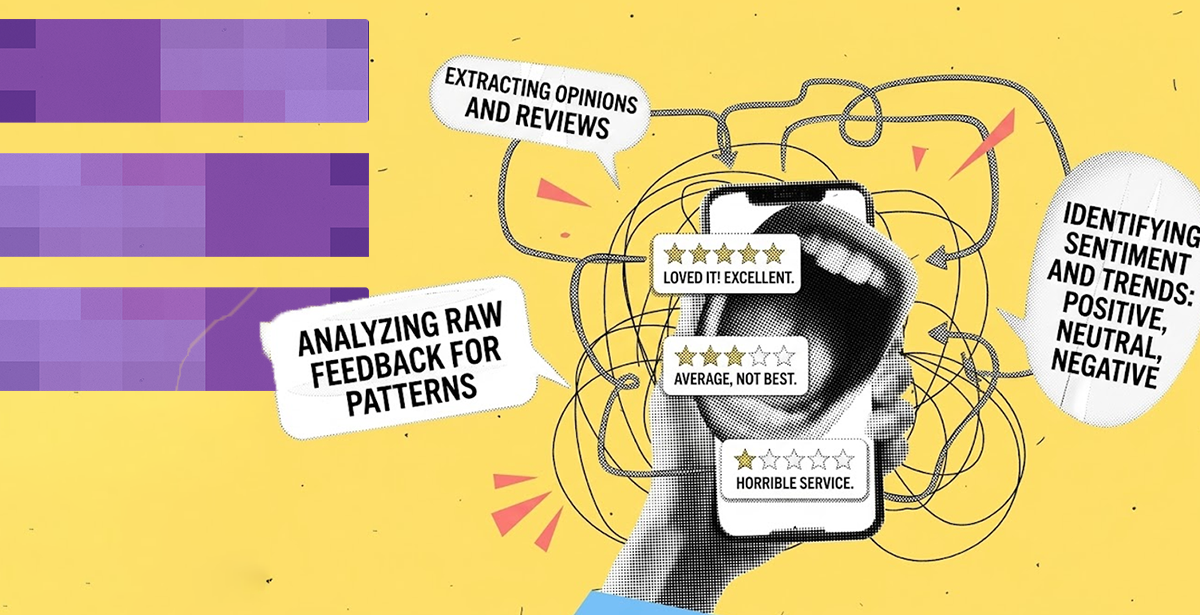
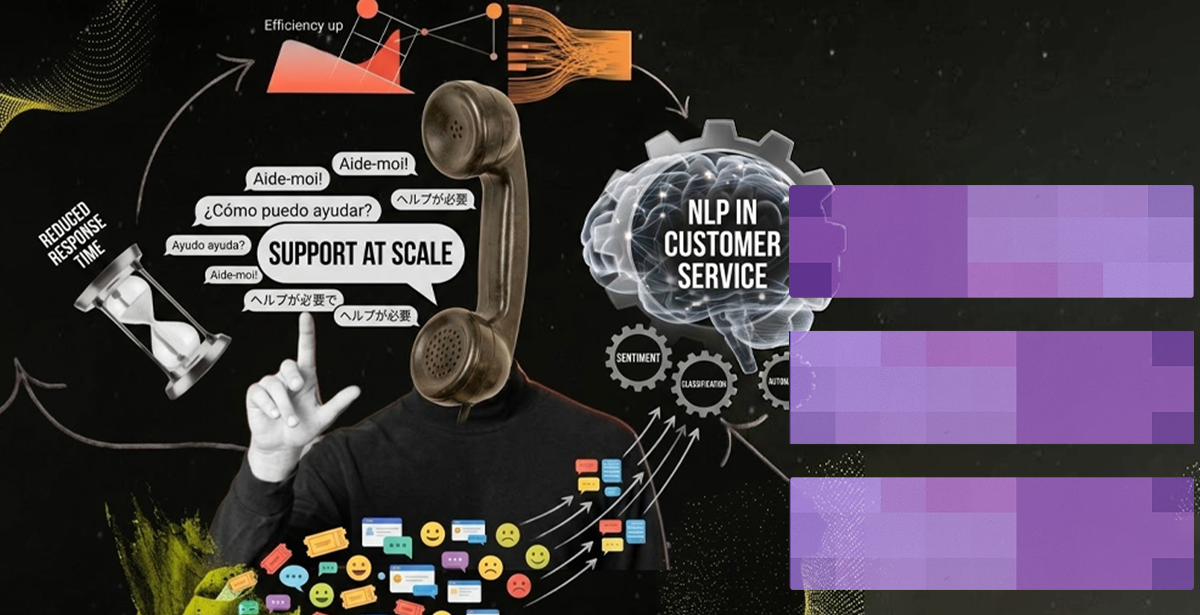
- Sentiment Analysis – Models detect emotional tone in real time. Frustrated customers get flagged for immediate human escalation, stopping churn before it happens.
- Intent Recognition – This is the engine of any capable NLP chatbot. The system identifies why a customer is reaching out and what they’re referring to, enabling accurate responses without a human in the loop.
- Ticket Classification and Routing – NLP automates sorting and routing of inbound requests by topic, priority, and department. High-volume teams save hours every day.
- Multilingual Support – NLP models trained on multilingual data handle queries in dozens of languages. Global support becomes viable without proportional headcount growth.
- ASR and Voice Integration – Automatic Speech Recognition combined with NLP extends these capabilities to phone channels. Conversational AI customer service now spans every touchpoint.
The Business Case for AI Customer Service Automation
The ROI of AI customer service automation is measurable. IBM’s research on natural language processing confirms that NLP-based systems reduce the cost of routine query handling while improving consistency at enterprise scale.
Key outcomes organizations are achieving with NLP customer support:
- Faster Resolution – NLP chatbots handle common queries in seconds, with no hold times or queue delays.
- Higher Deflection Rates – Well-built systems deflect 40–60% of inbound tickets from human agents, freeing teams to focus on complex interactions.
- Consistent Quality – AI doesn’t have days off. Every customer gets the same accurate, brand-aligned answer.
- Round-the-clock Availability – NLP systems run continuously, covering off-hours and peak volumes without overstaffing.
Salesforce’s State of Service research reinforces this urgency: customers expect fast, connected, personalized support regardless of channel. And NLP is the infrastructure that delivers it.
What Goes into Conversational AI Development for Support
Conversational AI development for customer service involves several engineering layers working in concert. Getting it right takes more than picking a model.
- Domain Fine-tuning – Generic language models underperform without fine-tuning on your actual queries, resolutions, and product terminology.
- Intent Taxonomy Design – Before building, teams map the full universe of customer intents. This strategic work shapes every downstream decision.
- Backend Integration – An NLP chatbot disconnected from order history, account status, or ticket context is limited. Real value comes from live system integration.
- MLOps and Continuous Improvement – Models drift over time. Customer language evolves, products change, and edge cases accumulate. Production NLP systems need monitoring, retraining pipelines, and human-in-the-loop review to stay sharp.
This is the end-to-end conversational AI development you can expect from top-notch teams, covering model selection, integration, and ongoing support.
NLP in Practice: DPL Case Studies
Over the past years, we’ve worked on several projects that leverage NLP. The following two show what it looks like when it’s genuinely embedded in a customer-facing product. Neither is a conventional support desk, but both tackle the same core challenge: understanding what a person means and responding in a way that helps them.
1) Pause. Breathe. Reflect. (PBR) — AI Mindfulness Chatbot
DPL built Michael, an emotion-aware AI chatbot that detects user sentiment in real time, understands intent, and recommends personalized practices from a library of 1,000+ guided sessions.
The NLP pipeline handles the full conversation loop: reading emotional cues, mapping intent, generating a contextual response.
The result: 12,000 paid users in 30 days, a 4.9-star rating, and reach across 200+ countries. This is NLP doing exactly what it does in support automation: listening, understanding, and responding at scale.
2) Sindh Ombudsman — AI-Powered Complaint CRM
Pakistan’s Sindh Ombudsman handles thousands of citizen complaints, but manual categorization was creating bottlenecks.
DPL deployed an AWS Bedrock-powered CRM that uses NLP to automatically classify incoming complaints by category, priority, and routing destination, with 92% AI accuracy.
Processing time dropped 65%. Citizen satisfaction rose 42%. The underlying capability, i.e. reading unstructured text and extracting actionable signals, is the same engine that powers ticket routing in enterprise customer support.
Building NLP Customer Support With DPL
We’ve created NLP and conversational AI systems for a range of clients across industry verticals. Our engineers work with leading LLMs — OpenAI, Llama, Mistral, and others — alongside multilingual chatbot frameworks, sentiment analysis pipelines, and ASR/TTS systems.
So, if you need experts to build custom NLP customer support solutions engineered for the complexity of your environment and the scale of your operation, we’re up for the task. Explore our AI engineering services to see the full scope of what we deliver.
Bonus: Natural Language Processing in Customer Service FAQs
What is the difference between an NLP chatbot and a rule-based chatbot?
Rule-based chatbots follow fixed scripts and break when customers phrase things differently. Meanwhile, NLP chatbots understand intent from natural language, handling variation, typos, and ambiguity far more gracefully.
How long does NLP customer service deployment take?
A proof of concept can be delivered in 6–10 weeks. Full production deployment, including integrations and fine-tuning, typically takes 3–6 months depending on complexity.
Can NLP customer support handle multiple languages?
Yes. Multilingual NLP and multilingual chatbot development are core DPL capabilities, enabling consistent support across language barriers without rebuilding your stack.